Maximum file size: 50MB For entertainment only
AI reads your photo and estimates how old you look
For entertainment only. AI model estimates apparent age from your photo — lighting and photo quality affect the result significantly.
Your photo
For entertainment only. Lighting and photo quality affect this estimate significantly. Take the number with a smile.
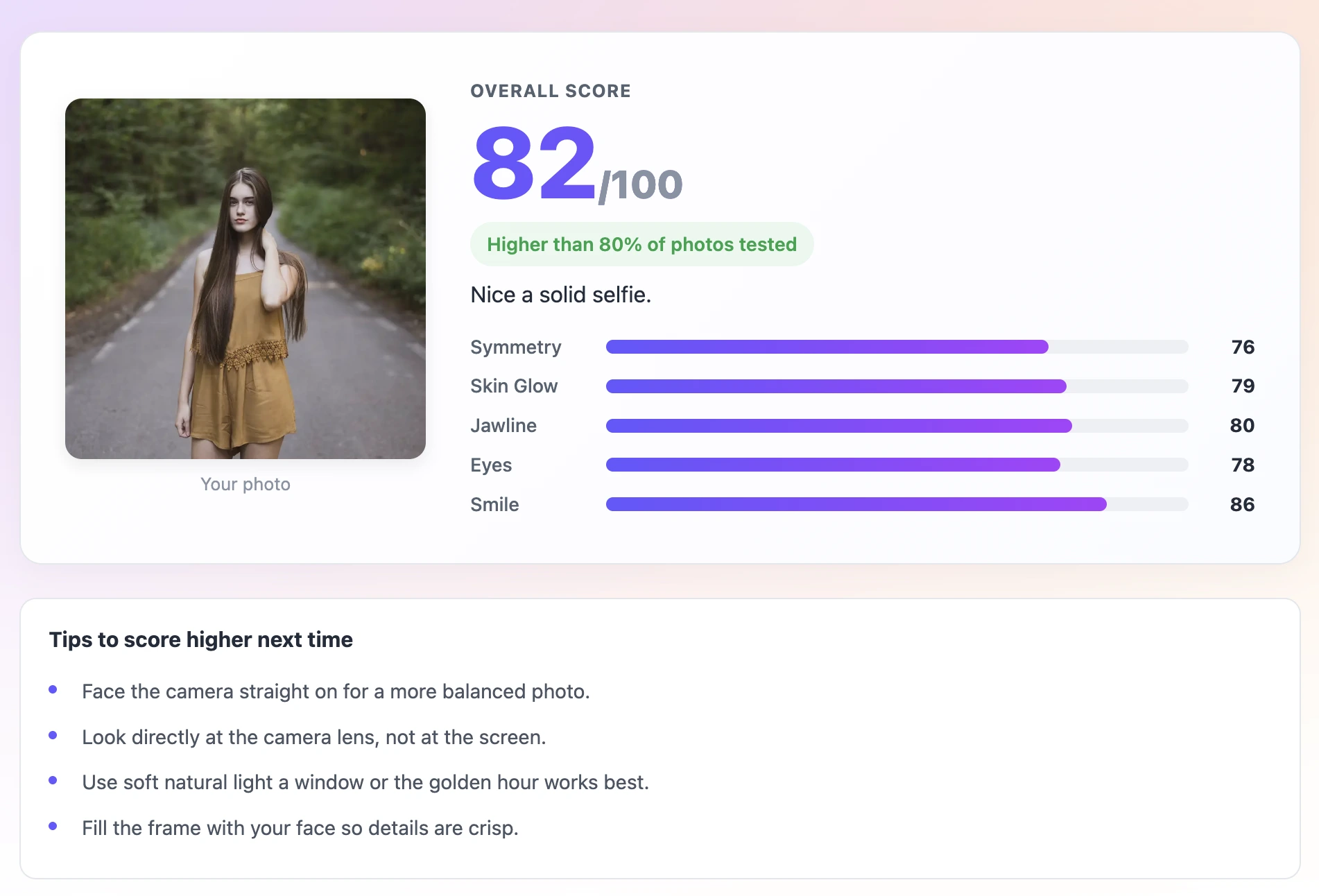
Pick any photo — an everyday selfie, an old photo, a photo from a few years ago. The AI will work with whatever you give it.
The AI commits to a specific age. It takes a few seconds. Check whether the guess is younger or older than your real age.
Download the result card and share it. Ask your friends if they agree with the AI. Then make them upload theirs.
Challenge the AI
Can the AI guess your age from a single photo? Upload a selfie and find out. The AI makes its guess in seconds. Then share the result and see how far off it was. Some guesses will surprise you. Others will be uncomfortably accurate. Either way, it is more fun when you do it with other people — upload yours, share the result, and dare your friends to beat it.
Upload a photo and the AI commits to a number. No hedging, no range — one specific age estimate that you can check against your real age.
The breakdown shows which categories pushed the estimate up or down. Was it lighting? Expression? Find out what tricked the AI and use that to craft a better or more surprising result.
Upload a photo where you look your youngest. Then upload one where you look your oldest. See how many years apart the AI estimates. The bigger the gap, the better.
The AI runs in your browser. Your photo never leaves your device. You decide what to share.
Open on iPhone or Android, upload from your camera roll, and the guess is back in seconds. No app, no account.
Download the result card and share it in a group chat. How many people agree with the AI? Start the conversation.
Yes — and it is surprisingly good on well-lit, clear photos. On an everyday selfie with average lighting, the AI is typically within 3 to 7 years of the real age. On a great photo with excellent lighting, it can be within 1 to 3 years.
Where it gets interesting is on unusual photos. Old photos from different eras of photography confuse it. Photos with extreme lighting mismatches produce wildly off estimates. Photos taken after an all-nighter consistently read older than the person is. Photos taken after a holiday in good outdoor light consistently read younger.
This is the fun part: the AI's guesses are not random. They are responding to real signals. When it guesses wrong, the reason is usually something specific and identifiable in the photo.
Here are the most interesting experiments to run with the age guesser:
Same person, two lighting conditions. Take a photo in overhead indoor light, then take one near a window in natural light. Compare the age estimates. The difference is usually 5 to 10 years — entirely caused by lighting, nothing else.
Same person, tired vs. rested. Take a photo early in the morning after a good sleep versus late at night after a long day. The AI consistently estimates 3 to 7 years older in the tired photo. Eye openness and expression drive this.
Old photos from different years. Pull up photos from 5 and 10 years ago. See whether the AI estimates match how you looked at those ages. It often gets surprisingly close on photos from the same era.
The oldest selfie you have vs. the youngest. Find the photos from opposite ends — the one where you looked most tired and worst, and the one where you looked your absolute best. The estimated age gap between them is usually fascinating.
Three main signals drive the estimate:
Want to make the AI guess the youngest age possible? This combination works every time:
Save TextBehindImg
Press Ctrl+D (or ⌘D on Mac) to bookmark and come back anytime it's free forever.