Maximum file size: 50MB For entertainment only
Fast, private, and just for fun
For entertainment only. Real attractiveness cannot be measured by any tool.
Your photo
For entertainment only. Attractiveness is not something a number can measure. Take your score with a smile.
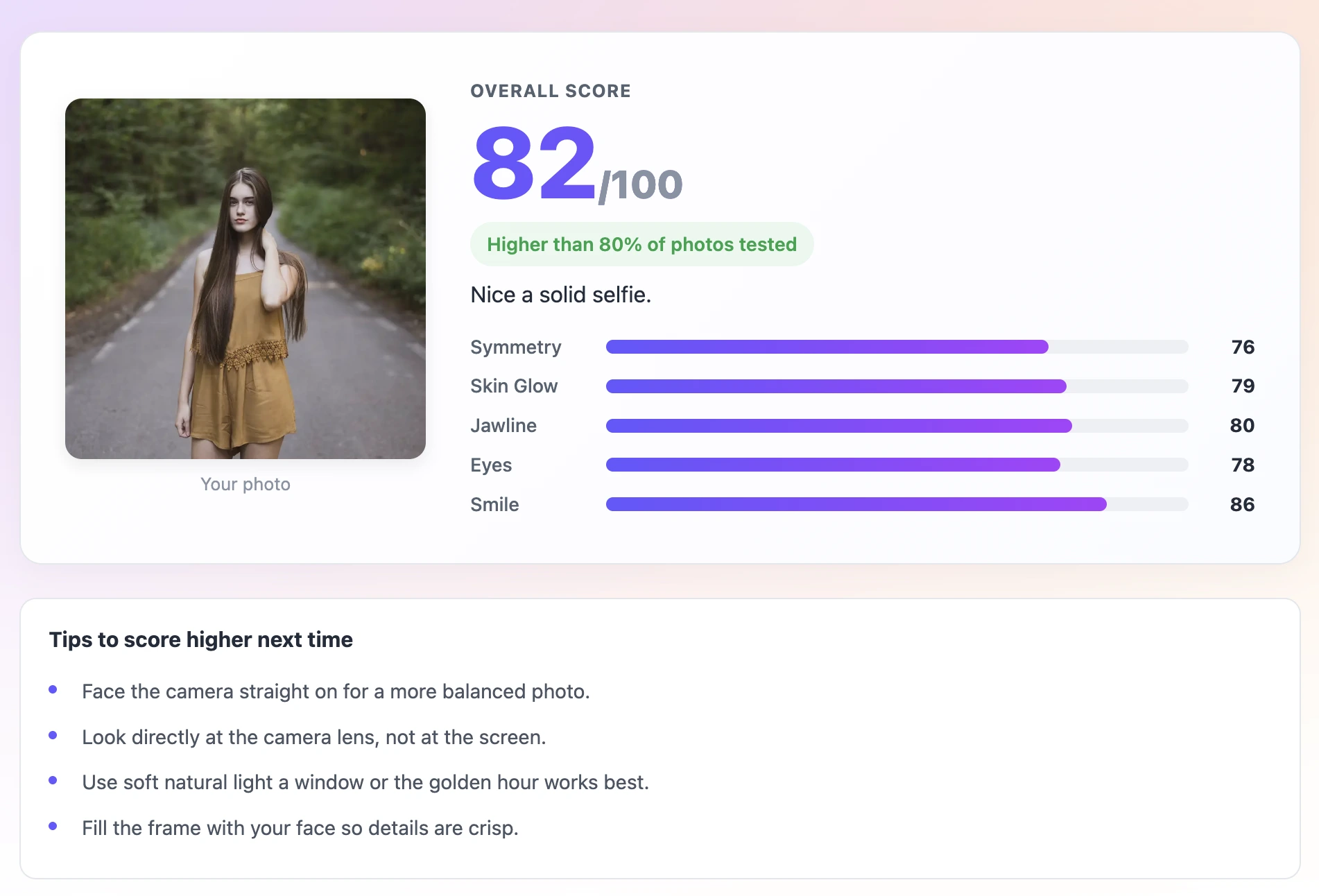
Pick a clear, front-facing selfie. The AI needs to detect key facial landmarks — good lighting and a forward-facing angle give it the most data to work with.
The AI scans the image for facial geometry, light distribution, edge sharpness, and structural signals. It takes a few seconds and runs entirely inside your browser.
Your score and category breakdown show what the AI measured. Try the same selfie with better lighting and watch the AI's reading change — it reveals what the model is actually sensitive to.
How AI Reads Your Face
The AI Attractiveness Test shows you exactly what artificial intelligence detects when it looks at a face. Upload a selfie and the AI measures things like facial geometry, brightness distribution, edge sharpness, and symmetry ratios — then translates those signals into a score. This is not a random number. It is what computer vision actually sees in your photo, explained.
The AI uses the same type of analysis that powers face detection in cameras and social apps. It measures geometry, light distribution, and structural balance — not opinions.
Symmetry ratio, skin luminance, jawline definition, eye clarity, and smile tension — these are the five face signals AI can actually measure from a still image.
Upload the same selfie in two different lighting conditions and watch the scores change. The AI is reading the photo, not your face — which is a fascinating experiment.
The AI model runs locally inside your browser using JavaScript. Your photo never leaves your device. No server sees it.
iPhone Safari, Android Chrome, desktop Firefox or Edge — the AI runs anywhere without an app or plugin.
Every score comes with a shareable result card. Post it or use it to start a conversation about what AI can and cannot measure about a face.
When the AI analyzes your selfie, it is not making a human judgment. It is running mathematical operations on pixels. Here is what actually happens:
First, the model locates the face in the image by looking for patterns it was trained to recognize as face-shaped regions. Then it identifies landmarks — the positions of eyes, nose, mouth, chin, and cheekbones.
Next, it runs measurements between those landmarks. How far apart are the eyes relative to the width of the face? How close is the chin to the golden ratio proportions? How evenly distributed is brightness across the face region? How sharp are the edges of features like the jawline and eyes?
These measurements get fed into the scoring model, which converts them into numbers for each category. That is what you are seeing in your score breakdown — not opinions, but geometric and photometric measurements.
This is the more important point. AI face scoring misses almost everything that matters about attractiveness in real life.
It cannot see how you carry yourself. Confidence changes how attractive a person appears dramatically — but it does not show up in a still photo score.
It cannot read your expression beyond basic geometry. A genuine smile that reaches your eyes may register as slightly better symmetry and eye openness, but the warmth behind it is invisible to the model.
It cannot read context. The same face looks more attractive in a relaxed, natural setting than in a forced or staged one — but the AI only sees the pixels.
It cannot account for individual taste. What one person finds attractive differs significantly from what another does. The AI was trained on population-level patterns, not individual preferences.
The best way to understand what AI is really measuring is to run an experiment. Take two selfies: one in a dark room with only your phone screen lighting your face, and one standing near a window in natural daylight. Upload both and compare the scores.
The difference in score will almost certainly be large — 15 to 30 points in most cases. But you look the same in both photos. The AI is not rating your face; it is rating the photo.
This tells you something useful: most of the variation in your score across different selfies is explained by lighting, not by your face. Get the lighting right and your score will improve immediately.
Indirectly, yes. Since the AI measures things like brightness, sharpness, and symmetry — and those same things affect how good a photo looks to a human viewer — a higher AI score often does mean a more appealing photo.
That is the practical use case: run the test on several selfies, pick the one with the highest score, and use that as your profile picture. The score is a rough proxy for photo quality, and improving your photo quality is something you can actually control.
Do not try to improve your score by improving your face. Try to improve it by improving the photo: better light, better angle, better expression. That is what the AI responds to.
Save TextBehindImg
Press Ctrl+D (or ⌘D on Mac) to bookmark and come back anytime it's free forever.