Maximum file size: 50MB For entertainment only
AI reads your photo and estimates how old you look
For entertainment only. AI model estimates apparent age from your photo — lighting and photo quality affect the result significantly.
Your photo
For entertainment only. Lighting and photo quality affect this estimate significantly. Take the number with a smile.
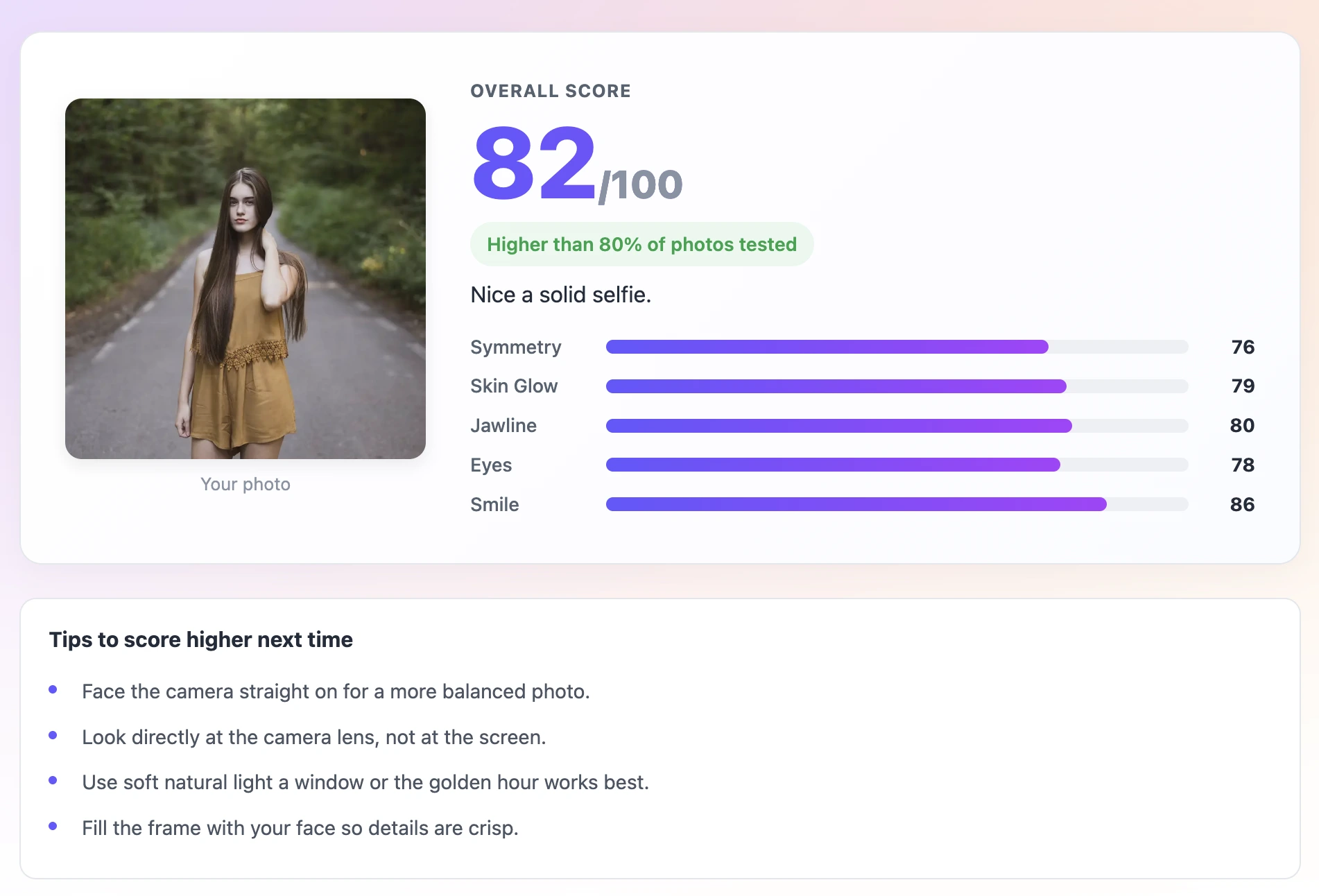
Pick a selfie without telling anyone what age you are. The AI makes its guess based entirely on the photo — no other information.
See the AI's age guess and the signal breakdown. Do not reveal your real age yet.
Post the AI's guess and ask your followers if it is right. Then reveal your real age. The bigger the miss, the more interesting the reaction.
Did the AI Get It Right?
Upload a selfie, see the AI's guess, then reveal whether it was right. Share the result and start the debate. The AI is sometimes shockingly accurate. Other times it misses by 15 years. Both outcomes are fun — especially when your friends find out the AI got them wrong and you got right.
The AI does not hedge. It picks a specific age for your photo. Check whether it is right, close, or wildly off.
The breakdown shows what signals drove the guess. Was it the lighting? The expression? The jawline? Find out exactly what fooled the AI or confirmed its guess.
Was the AI right? Post your result and let your followers decide. The comments section basically writes itself when the AI gets it badly wrong.
The AI runs in your browser. Your photo never leaves your device. Nothing is stored or uploaded.
Open in Safari or Chrome, upload a photo, and the guess is back in seconds. Works on iPhone, Android, and desktop.
Download a shareable card showing the AI's guess. Perfect for a before-and-after reveal post — AI guess first, your real age second.
The AI is right more often than people expect on good photos — usually within 3 to 5 years on a sharp, well-lit selfie. That is actually impressive when you think about it. The model is reading pixel-level signals about skin texture, eye openness, and brightness distribution, and converting those signals into a number that often lands close to the truth.
Where it goes wrong is predictable. Harsh lighting that creates deep shadows makes the AI read texture as age. Tired eyes that are partially closed make it estimate older. A very blurry photo gives it low-quality signals and it defaults to a wider, less confident guess.
The interesting cases are when someone looks young for their age in a great photo and the AI guesses 10 years younger than they are. That is the AI accurately reading the photo — the person genuinely appears that age in that image. Whether that is because of good genetics, good lighting, or both is a different question.
The most fun version of this is the reveal format:
First, upload your photo without telling anyone your real age. Screenshot the AI's guess. Post the screenshot and ask people to vote: was the AI right? Older or younger? Start the debate.
Then reveal your real age. If the AI was right, that is one kind of reaction. If the AI guessed 10 years younger, that is a better reaction. If the AI guessed 10 years older, that is the most interesting reaction — because then everyone wants to know why, and the signal breakdown usually has an answer.
This format works particularly well on Instagram Stories with a poll sticker, or in a group chat where everyone does it at the same time and compares results.
The age guess comes from four signals:
Take two photos back to back. In the first one: dim overhead lighting, no smile, slightly tired. In the second: facing a window in natural daylight, relaxed smile, eyes fully open.
Run both through the age guesser. The difference in estimated age between the two photos is almost always between 8 and 15 years — for the same person taken minutes apart.
That tells you most of what you need to know about how the AI works. It is not reading your face. It is reading your photo. Get better light, and the AI guesses younger.
Save TextBehindImg
Press Ctrl+D (or ⌘D on Mac) to bookmark and come back anytime it's free forever.