Maximum file size: 50MB For entertainment only
Fast, private, and just for fun
For entertainment only. Real attractiveness cannot be measured by any tool.
Your photo
For entertainment only. Attractiveness is not something a number can measure. Take your score with a smile.
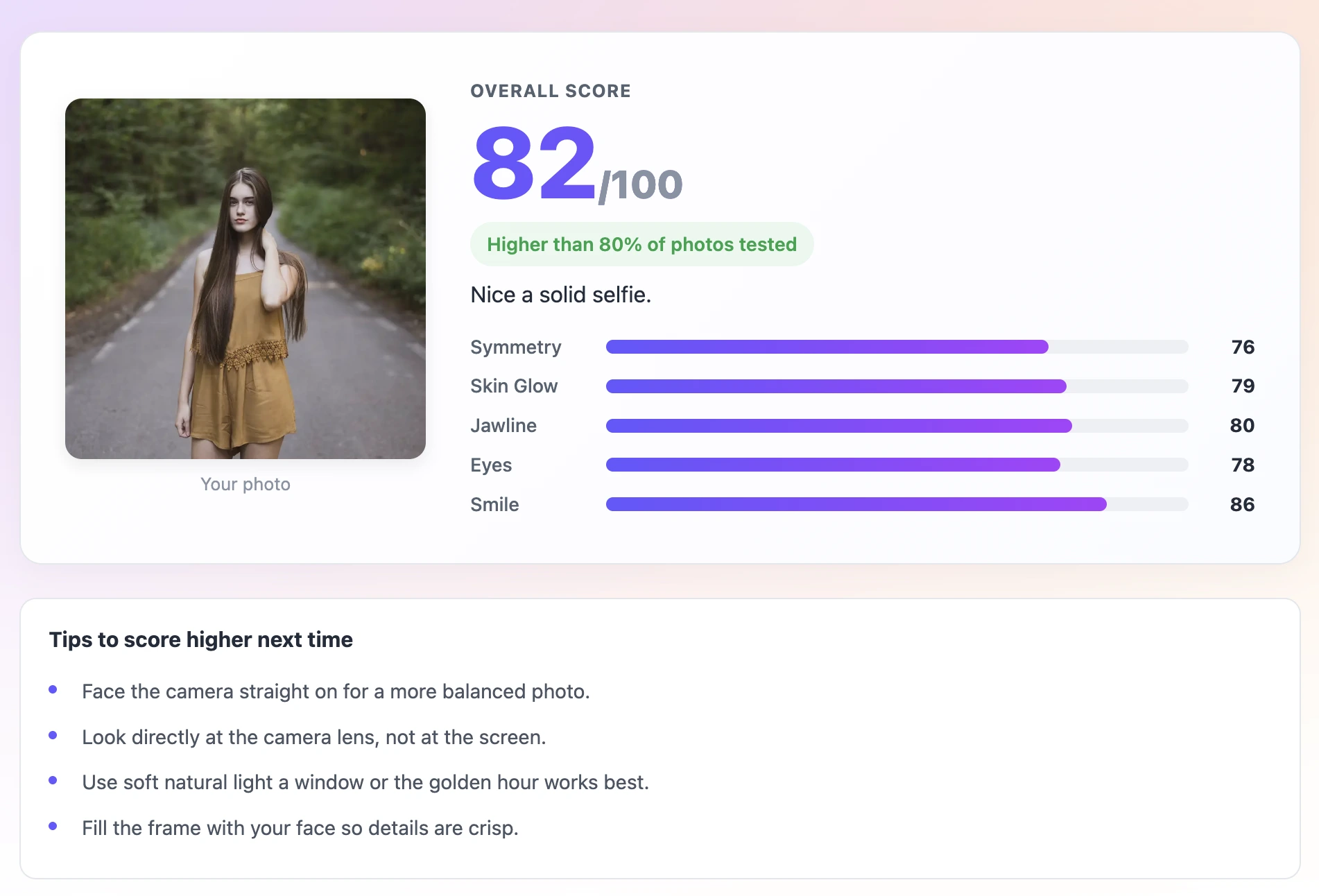
Upload a selfie where you think you look good. Soft natural light, face centered, expression natural. The score will tell you which parts of that photo are actually working.
Look at each category score individually, not just the total. Symmetry, glow, jawline, eyes, smile — find out which ones are pulling your score up and which ones have room to grow.
Follow the specific tips in your result. Then try another selfie with those changes and compare. A 10-15 point improvement from better lighting alone is completely normal.
Getting an Honest Answer
If you are genuinely asking how attractive you are, a photo score can give you part of the answer — the part that has to do with how your photos look. Upload a selfie and you will get a score out of 100 with a breakdown showing exactly what is working and what you could change. More importantly, you will get specific tips that actually help. Runs privately in your browser, free, no account needed.
You do not just get a number. Each category comes with specific context so you understand what earned your score and what you could do differently.
The result comes with personalised photo tips based on your specific score breakdown — not generic advice but suggestions tied to where you actually scored lower.
Try a photo before implementing the tips, then try again after. See how much your score improves when you change lighting, angle, or expression.
Your photo stays on your device. Nothing is uploaded. You are the only one who sees your score unless you choose to share it.
Take a fresh selfie and upload it immediately. Works in Safari on iPhone and Chrome on Android with no extra steps.
Your result card is yours to keep or share. Post it, compare with friends, or save it privately — your choice.
There are two parts to this question. The first part is the one this tool can help with: how does your photo score on measurable properties that affect how attractive you look in images? That is a real question with a real answer.
The second part is harder and more important: how attractive are you as a person? That depends on confidence, humor, warmth, how you make people feel, and a hundred other things that no selfie captures. A photo is a frozen moment in two dimensions. The full version of you is none of those things.
Use the score for what it is good at: helping you take better photos. Ignore it for everything else.
Four things drive almost all of the variance in how attractive someone looks in a photo:
Lighting is the biggest one. Soft, even light from the front makes skin look smooth, eyes look bright, and the whole face look alive. Harsh or unflattering light does the opposite. This is why professional headshots almost always use carefully controlled lighting — it does most of the work.
Expression matters more than most people realise. A genuinely relaxed, happy expression beats a forced smile every time. The difference between a tense expression and a relaxed one can move a score by 10 or 15 points and will be obvious to every person who looks at the photo.
Angle and framing affect how your facial structure reads. A straight-on, slightly elevated angle is the most universally flattering. Looking down at the camera from above tends to make eyes look larger. Looking up tends to emphasise the jawline.
Photo quality — sharpness, resolution, and lack of blur — affects how well the AI can read your features and how good the photo looks to a human viewer. A sharp photo always looks better than a soft one.
Research on attractiveness consistently finds that how a person looks in photos is only weakly correlated with how attractive people find them in real life. The factors that matter most in person — presence, humor, energy, confidence, warmth — are invisible in a still image.
There is a well-known finding in psychology called the halo effect: people who are rated as attractive in photos get higher ratings on personality traits too. But the reverse is also true: people who come across as warm, funny, or confident in real life are rated as more attractive than their photos suggest.
So a higher photo score is a good thing. A lower one does not mean what you might fear it means. It almost always means the photo could be better — not that you could be better.
If you want to improve your score immediately:
Save TextBehindImg
Press Ctrl+D (or ⌘D on Mac) to bookmark and come back anytime it's free forever.